The Cosgrove
Columbia, Tennessee · 36 units · Acquired July 2021
The Cosgrove is a textbook multifamily value-add. We bought this mixed-vintage community under a manager who was not doing the job, took over operations directly, restored its occupancy in three months, then rebuilt it into a fully renovated, 97% occupied asset that refinanced into agency debt. This is the operational execution behind a property we still hold.
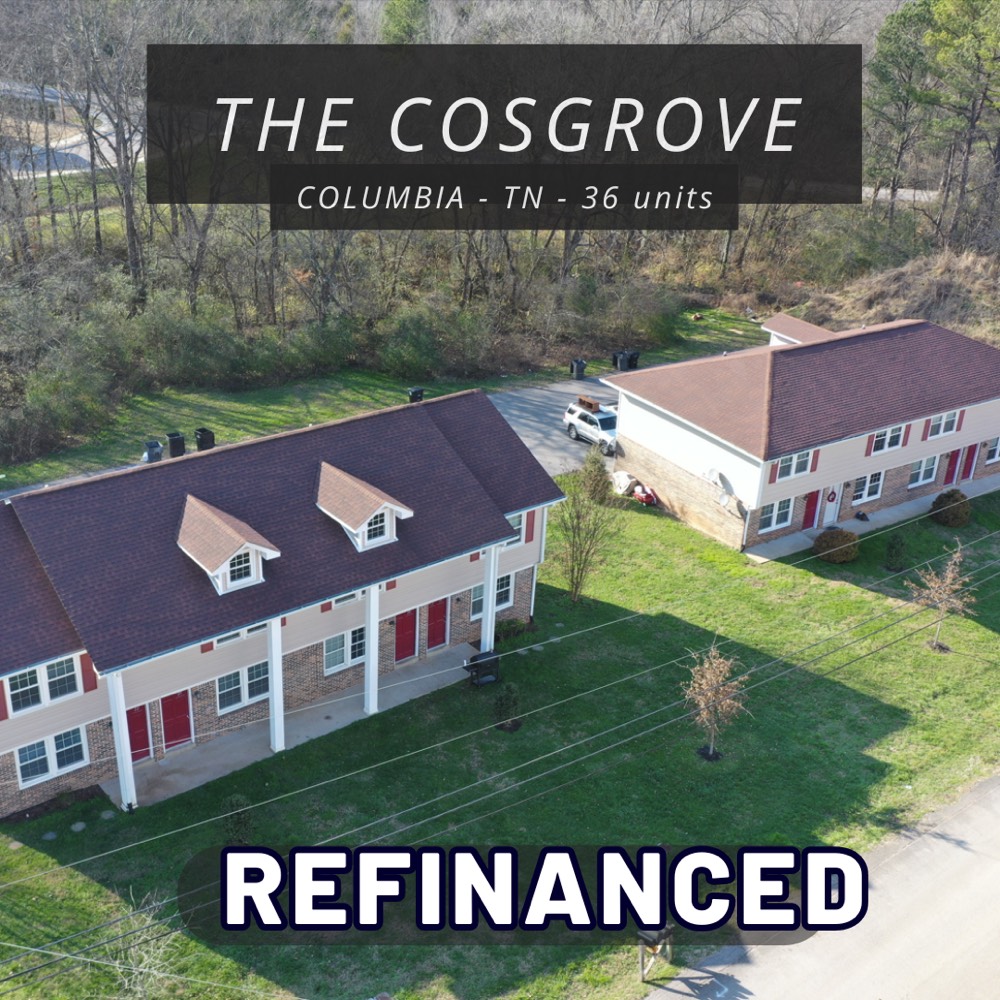
A multifamily value-add means buying an underperforming apartment community, fixing its operations and physical condition, and raising income so the asset is worth more. The Cosgrove, 36 units in Columbia, Tennessee, is a real example. We bought it in 2021, inherited a mismanaged rent roll and roughly $196,000 in damage, and took over operations directly to restore occupancy in three months. Over the hold we renovated every unit for $836,254 and re-based average rents from about $847 to $1,425, a 68% increase, stabilizing at 97% occupancy, 35 of 36 units. Purchased for $4,425,000 and renovated for $836,254, an all-in basis of $5,261,254, it appraised at $6,900,000, roughly $1,638,746 of value created above basis, then refinanced into agency debt and held long-term.
The asset
The Cosgrove is a 36-unit community in Columbia, Tennessee, about an hour south of Nashville. It is a mixed-vintage property: 30 two-bedroom townhomes built in the 1970s and 6 three-bedroom units added in 2019. We acquired it in July 2021.
What we inherited
The property did not come to us stabilized. The third-party manager in place was not doing the job. Work orders went uncompleted. Units reported to us as leased were sitting empty. Evictions we were told had been filed had not been. Security deposits were not being collected. By the time we had the full picture, we were working through roughly $196,000 in damage.
Rather than swap one manager for another and hope, I took over operations directly. Within three months we had the property leased back up on real, verified numbers, an honest rent roll in place of a reported one. That reset was the foundation for everything after it.
The business plan and execution
The plan was straightforward and the execution was not glamorous. We renovated every unit, investing $836,254 over the hold, roughly $23,200 per door. Renovated units let us re-base rents to what the market would actually pay rather than the legacy numbers on the old rent roll.
Underneath the renovation, we rebuilt the operations. We tracked physical occupancy, economic occupancy, and the pre-leased pipeline on every call rather than managing to one number. We tightened collections, tracking every promised payment date to a uniform filing threshold applied the same way to every resident. We held renewals steady rather than reflexively pushing increases, keeping paying residents in place. And we reset our financial review to audit-level, re-checking per-unit costs every month instead of accepting statements at face value after we caught inconsistent third-party accounting inflating costs elsewhere in the portfolio.
None of this was a straight line. Occupancy dipped during the heaviest renovation period as we turned units, then recovered. That is what a real value-add looks like on the ground: you take short-term occupancy pain to reposition the asset, then you stabilize it higher than where you started.
The results
Over the hold, average in-place rent grew from about $847 to about $1,425 a month, a 68% increase, on fully renovated units. Occupancy was restored to 97%, 35 of the 36 units, with the last vacancy pre-leased. The distressed, high-delinquency rent roll we inherited became a clean, current one a lender could underwrite.
In July 2026, the property refinanced into agency debt. It was purchased for $4,425,000 on $1.4 million of raised equity. With $836,254 of capital invested, the all-in basis was $5,261,254 against a $6,900,000 appraisal, roughly $1,638,746 of value created above basis through operations and capital improvements. The refinance returned 52% of investor capital while we retained full ownership of the asset. We refinanced rather than sold. This is a long-term hold, and the agency financing lets us keep operating the property for the years ahead. The refinance was not the strategy. It was the proof that the operational work had produced a genuinely financeable asset.
The takeaway
A refinance and an appraisal are lagging indicators. They follow the operations, not the other way around. The Cosgrove got there because of unglamorous, repeatable work: renovate every unit, re-base rents to reality, tighten collections to a uniform policy, keep the financials audit-clean, and let the building prove itself on the page before the lender ever sees it. That is the discipline we run across the portfolio.
Want to run the same math on a deal you are looking at? Our free cap rate calculator turns a purchase price and income into NOI, cap rate, and the value that operational improvements like these create.
Common questions
What is a multifamily value-add strategy?
A multifamily value-add is buying an underperforming apartment property, improving operations and physical condition, and raising net operating income so the asset is worth more. On the Cosgrove we restored occupancy, renovated every unit, re-based rents to market, and tightened collections before the value ever showed up in an appraisal.
How long does a multifamily value-add take?
It depends on the property. On the Cosgrove we restored occupancy from distressed to stabilized in the first three months, then executed a full unit-by-unit renovation over the hold. We acquired it in 2021 and refinanced in 2026, so the repositioning ran across several years, not a quick flip.
Is it better to sell or refinance a stabilized value-add?
Both are valid. We refinanced the Cosgrove into agency debt rather than selling, which returned 52% of investor capital while we kept full ownership and future upside. A cash-out refinance is tax-deferred, not tax-free, and it keeps options open in a growing market; selling would have triggered tax and handed future income to a buyer.
What actually drives a multifamily value-add's results?
Operations, not financial engineering. The appraisal and refinance are lagging indicators that follow the work: renovate every unit, re-base rents to reality, tighten collections to a uniform policy, and keep the financials audit-clean. Results vary by property and are never guaranteed; the Cosgrove is one owned asset and is not representative of every deal.
This case study describes the operational execution of a single property we own and is provided for informational purposes only. It is not an offer to sell or a solicitation of an offer to buy any security, and it is not investment advice. This property is one example and is not representative. Not every property achieves results like these, and the past performance of one asset does not guarantee that any future investment will have similar characteristics or results. Figures are drawn from the property's own operating records and ownership's stated basis.
Get to know how we operate
We partner with a select group of investors on long-term multifamily holds like The Cosgrove. Tell us a little about yourself so we can get to know you and how you think about real estate. From there, we set up a call to understand your goals and make sure it is the right fit.
Book an intro call with MikeNot sure where you stand? Take the 2-minute investor readiness assessment.