Cash-Out Refinance on a Rental Property: The Cosgrove
By Mike Taravella · July 2026
A cash-out refinance on a rental property replaces your existing loan with a larger one and returns the difference to you in cash, based on the property's higher value, without selling the asset. It is tax-deferred, not tax-free: you keep the building, the rent, and any future appreciation, and you do not trigger a capital-gains bill the way a sale does. On The Cosgrove, a 36-unit community we bought for $4,425,000 in 2021 and stabilized to 97% occupancy, a 2026 appraisal came in at $6,900,000. We refinanced into agency debt rather than selling, which returned 52% of our investors' original capital in cash while they kept full ownership. The refinance follows the operations: it only works once real net operating income supports the higher value.
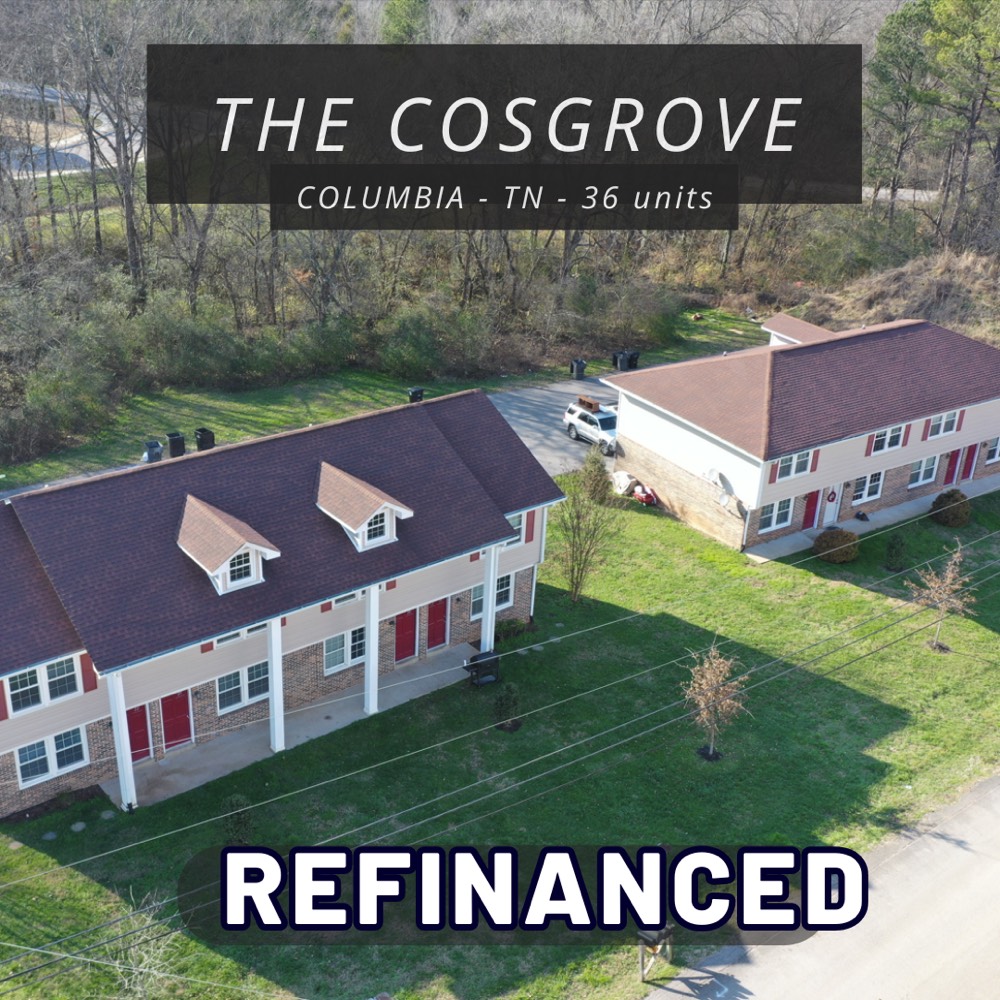
Most people think the only way to get money out of a rental property that has gone up in value is to sell it. It is not. A cash out refinance rental property strategy lets you pull capital out of the value you created, keep the building, and defer the tax you would owe on a sale. Here is exactly how that worked on a 36-unit deal we still own.
What a cash-out refinance on a rental property actually does
A cash-out refinance replaces your existing loan with a new, larger one and returns the difference to you in cash. The new loan is sized off the property's current appraised value, so when the value has grown, the gap between the old loan and the new one can be significant.
The part that surprises people is the tax treatment. Loan proceeds are not income, so you are not taxed on the cash you take out. That makes a cash-out refinance tax-deferred, not tax-free: you keep the asset, and the tax you would have paid on a sale is deferred until you eventually sell. You give up nothing on the upside. You still own 100% of the building and keep 100% of any future appreciation and cash flow.
A real example: The Cosgrove
We bought The Cosgrove, a 36-unit community in Columbia, Tennessee, for $4,425,000 in 2021, alongside our investors. This is the full value-add case study, so I will keep the operations short here: the property was mismanaged when we took it over, occupancy had slid, and I stepped in to run the day-to-day directly. Over the hold we renovated every unit, re-based rents from about $847 to $1,425, and stabilized the building at 97% occupancy.
In 2026 the property appraised for $6,900,000. That is roughly $2,475,000 of value created, and it was created by operations, not by the market.
We did not sell. We do not buy to flip. We refinanced into agency debt instead, on a five-year term at 6.11%, interest only. The cash-out refinance returned 52% of our investors' original capital to them in cash, and they still own the entire building.
Why we refinanced instead of selling
Selling would have felt like the finish line. It also would have triggered a tax bill and handed the next five years of income growth to a buyer.
A cash-out refinance did three things a sale could not. It returned capital to our investors now. It deferred the tax. And it kept the asset, its cash flow, and its future upside in our hands, in a market that is still growing. When you hold for the long term, a stabilized building in a good market keeps every option open, and the refinance is the move that funds your investors without closing any doors.
The part that makes it work
Here is the discipline underneath all of it: the refinance follows the operations. It is a lagging indicator.
An appraiser and a lender do not care about your business plan. They underwrite the income the building actually produces and the rent roll a lender can verify. The Cosgrove only refinanced because the net operating income was real, the collections were clean, and the rent roll was current. We did the unglamorous work first, restore occupancy, renovate, re-base rents to reality, tighten collections to a uniform policy, keep the financials audit-clean, and the financeable value followed.
That is the order that matters. If you are counting on a cash-out refinance to bail out a deal, the math will not be there. If you build genuine NOI first, the refinance is simply the proof that the work paid off. You can run the value-created math on your own deal with our free cap rate calculator, which turns an NOI improvement into the value it creates at your cap rate.
This describes the operational execution and financing of a single property we own and is provided for informational purposes only. It is not an offer to sell or a solicitation of an offer to buy any security, and it is not investment advice. This property is one example, is not representative, and the past performance of one asset does not guarantee similar results on any future investment. Figures are drawn from the property's own records and ownership's stated basis.
Common questions
What is a cash-out refinance on a rental property?
It is a new, larger loan that pays off your existing mortgage and hands you the difference in cash, sized off the property's current appraised value. You keep the asset and its future income and appreciation. The trade-off is a bigger loan and a higher payment, so it only makes sense when the property's net operating income comfortably covers the new debt.
Is a cash-out refinance on a rental property taxable?
Loan proceeds are not taxed as income, so a cash-out refinance is tax-deferred, not tax-free. You are borrowing against value, not selling it, so there is no capital-gains event at the refinance. The tax is deferred until you eventually sell. That deferral is a large part of why operators refinance instead of selling a stabilized asset.
Is it better to refinance or sell a rental property?
Both are valid and it depends on your goals. Selling gives you the full proceeds but triggers tax and hands future income to the buyer. A cash-out refinance returns capital now, defers the tax, and keeps the asset, its cash flow, and its upside in your hands. On The Cosgrove we refinanced because we hold for the long term and wanted to keep every option open in a growing market.
How much can you cash out when you refinance a rental property?
It depends on the appraised value, the lender's loan-to-value limit, and whether the property's net operating income supports the larger payment. Agency and bank lenders underwrite to a debt-service coverage ratio, so the ceiling is set by real income, not just value. The stronger and cleaner the rent roll, the more the property can responsibly support.
What makes a cash-out refinance actually work?
Operations. The appraisal and the loan are lagging indicators that follow real net operating income. On The Cosgrove we restored occupancy, renovated every unit, re-based rents to market, and tightened collections first; the refinance was only possible because the building genuinely produced the income to support it. Results vary by property and are never guaranteed.
Free tools from this system
Keep reading
How real estate syndication works, and how to vet the sponsor before you wire six figures. From an operator running 1,500 units across 48 properties.
Cap rate compression raises property value and expansion cuts it. See how rising interest rates push cap rates up, with the math on one point.